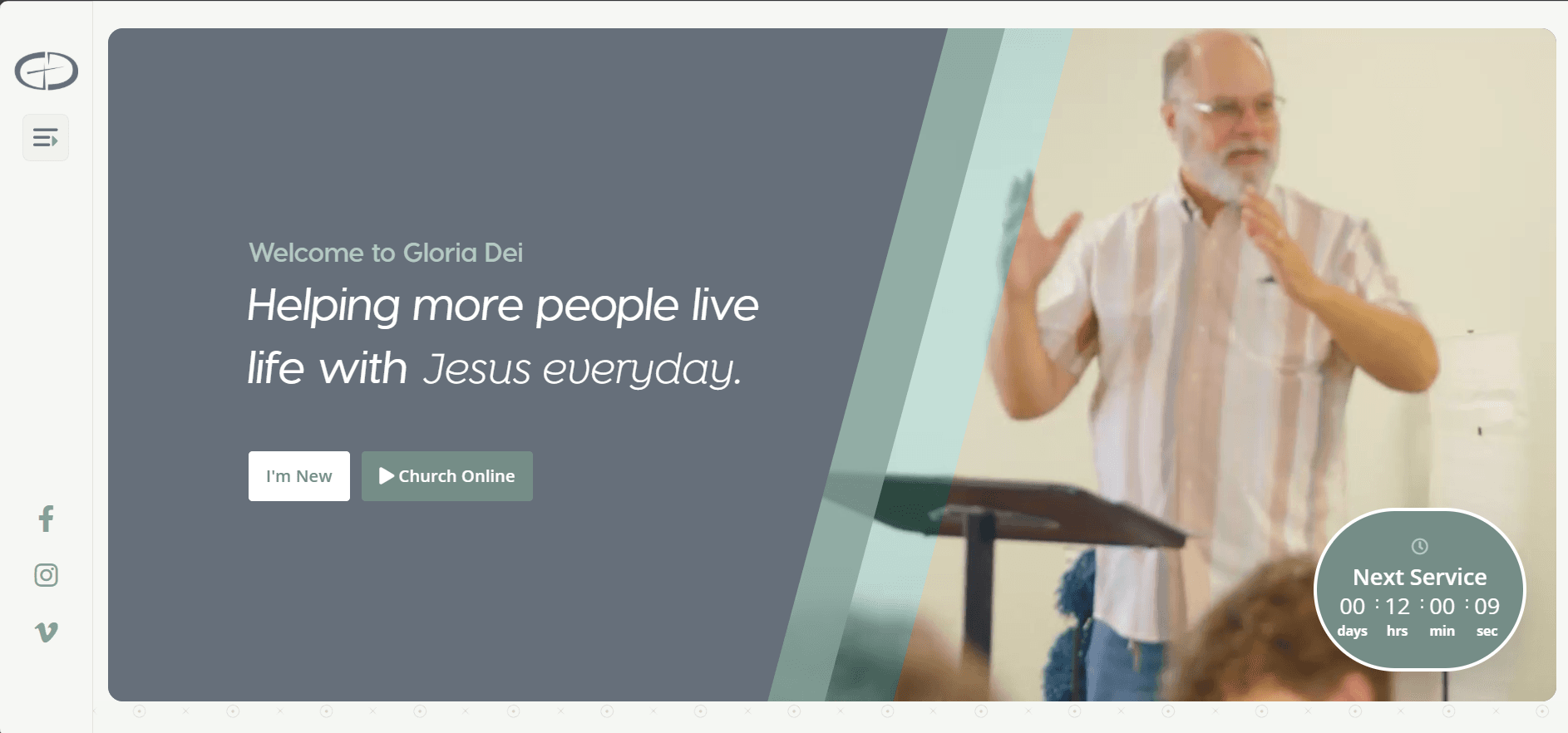
Gloria Dei Website





<p><em>Developer at Triumph Tech </em></p><h2>The Problem</h2><p>Gloria Dei Lutheran Church needed a modern, responsive website that their non-technical staff could update on their own. The site had to feel welcoming and polished while running entirely on RockRMS — a church management platform with its own templating language, block system, and layout constraints that don't work like a typical web framework.</p><h2>The Approach</h2><p>I was one of two developers on this project at Triumph Tech. I co-designed and built ~7 pages end-to-end, working within a strict internal style guide that dictated typography, spacing, component structure, and layout patterns. Pre-built components existed in the system, but I owned the page-level decisions — imagery, composition, animation, and making everything feel cohesive across devices.</p><p>Two things made this harder than a standard frontend build:</p><p><strong>The CMS fought the design.</strong> RockRMS has its own templating language and a rigid block/zone layout system. Getting custom, visually distinct page layouts to work within those constraints meant learning the platform's quirks and finding creative workarounds — you can't just write React components and call it a day.</p><p><strong>Spacing was the real craft.</strong> We paid close attention to padding, whitespace, and visual rhythm across every component and breakpoint. It sounds small, but consistent spacing is what separates a site that feels professional from one that feels like a template. Combined with smooth entrance animations and transitions, this attention to detail was the bulk of the work.</p><h2>My Role</h2><p>Developer at Triumph Tech, collaborating with one other developer. Gloria Dei was the most prominent project during my time at the company. I also worked on other client projects, but this was the one where I spent the most time and had the most ownership.</p><h2>The Result</h2><p>The site shipped and is live at <a target="_blank" rel="noopener noreferrer" href="http://gdlc.org">gdlc.org</a>. Church staff manage content through RockRMS without developer involvement. The site is responsive, consistent across devices, and visually polished — not something you'd guess was built on a CMS.</p><h2>What I Learned</h2><p><strong>Discipline beats preference.</strong> Working under a strict style guide taught me to build within a system rather than defaulting to whatever I thought looked best. That's a fundamentally different skill than solo development, and it's the one that matters on a real team.</p><p><strong>Component thinking scales.</strong> Building reusable shortcodes and modular components that other developers (and non-technical staff) could work with forced me to think about maintainability in a way personal projects don't. If only you understand how it works, it's not a real component.</p><p><strong>CMS constraints aren't limitations — they're the job.</strong> RockRMS isn't React. The language is unique, the layout system is rigid, and you're building within someone else's architecture. Learning to ship quality work inside those constraints — instead of complaining about them — is what professional development actually looks like.</p><h2>Access</h2><p><strong>Live Site</strong> <a target="_blank" rel="noopener noreferrer" href="http://gdlc.org">gdlc.org</a> <br><strong>Built at</strong> Triumph Tech </p>